
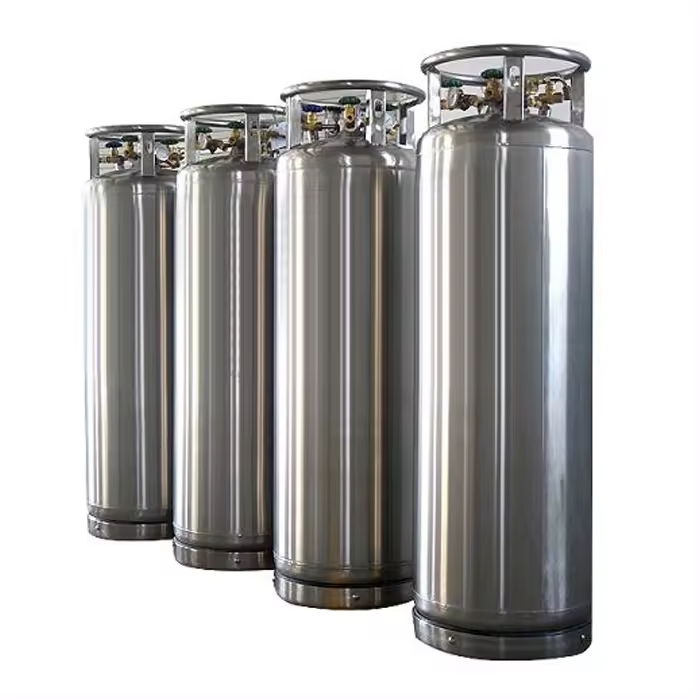
Cryogenic cylinders
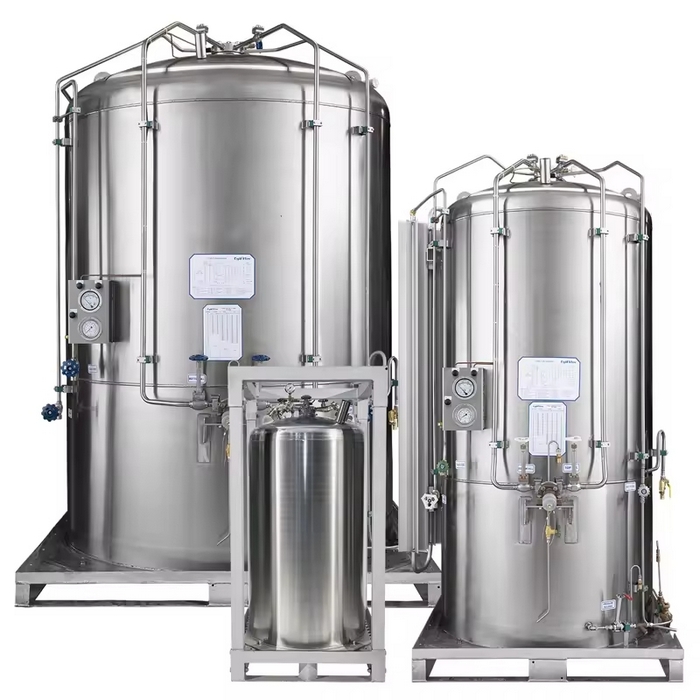
Cryocylinders are small volume cryogenic vessels designed for storage, transportation and gasification of liquid oxygen, nitrogen, argon and carbon dioxide.
They consist of an inner and outer tank, between which there is a screen-vacuum insulation. Thanks to an integrated vaporizer, the liquid gas is converted into a gaseous state by heat exchange with the inner surface of the outer tank.
Cryocylinders are equipped with all necessary shut-off, safety and control valves of the American company REGO. Application of cryocylinders helps to increase efficiency and economy of technical gases supply.
Benefits of cryocylinders:
one cryocylinder is capable of replacing 24 standard cylinders with a volume of 40 liters;
the equipment operates without the use of electricity;
one person is enough to operate it;
no product losses with constant minimum product withdrawal;
the inner container of the cryocylinder is made of stainless steel, which guarantees the purity of the gaseous product;
safety: the working process takes place at a pressure of up to 20 bar (unlike cylinders, where the pressure reaches 150 bar);
no costs for maintaining a fleet of cylinders and hiring additional workers.
| Medium | liquid natural gas, nitrogen, argon, oxygen, carbon dioxide |
| Volume | 210 l |
| Material of construction | stainless steel |
| Designation | transportation and stationary use |
| Configuration | inner and outer vessel, evaporator, shut-off, safety and control valves |
| Maximum working pressure | 3.5 bar |
| Operating temperature | - 196 °C |
| Capacity | 10 m³/h |
| Diameter | 505 mm. |
| Height | up to 1725 mm. |