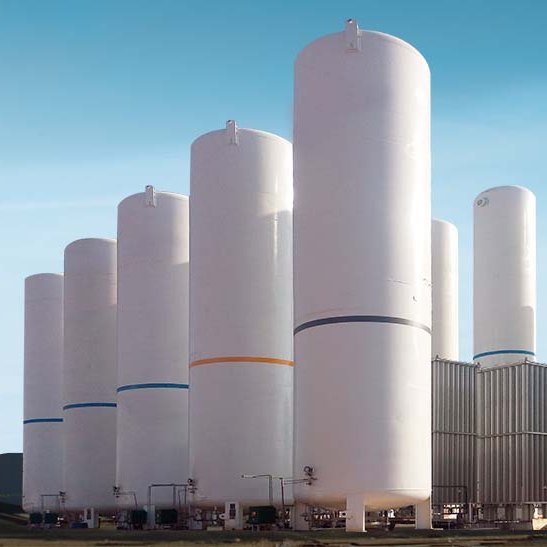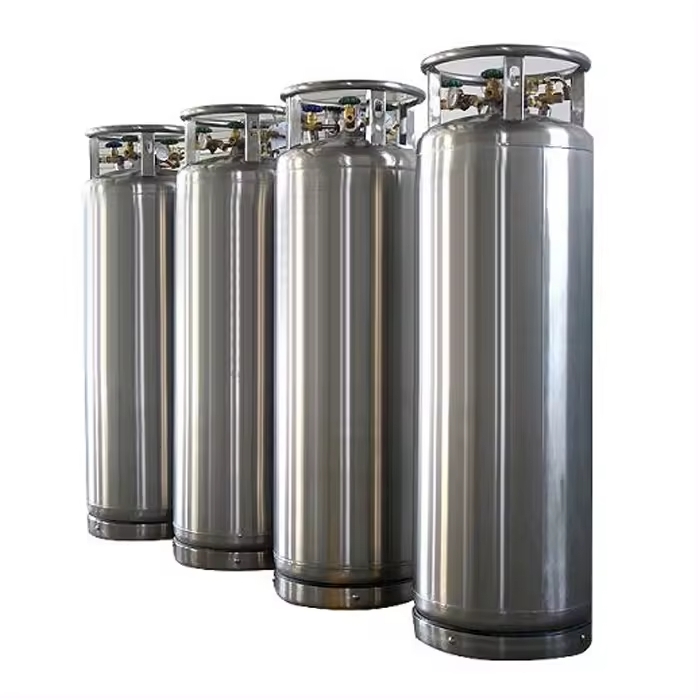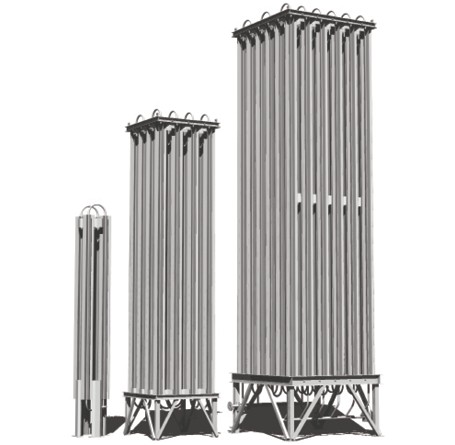

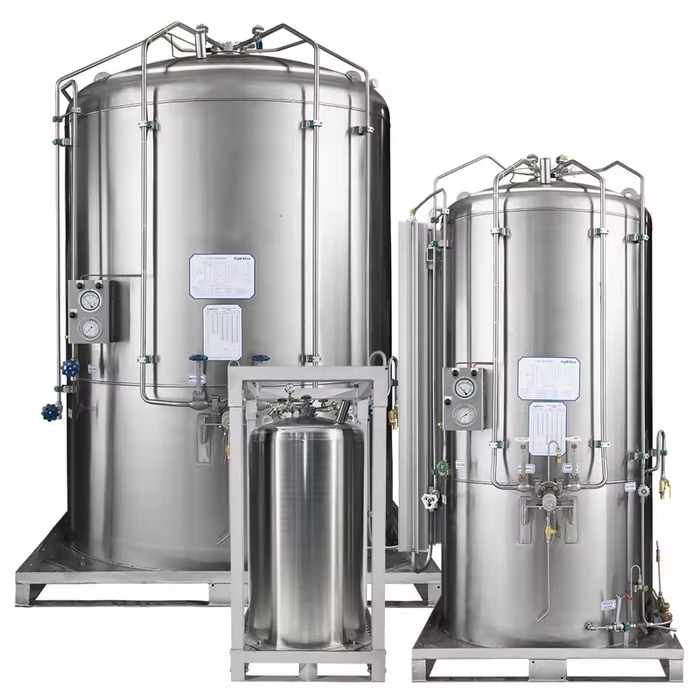
Cryogenic gasifiers (tanks)
Cryogenic gasifiers are specialized devices designed for the storage and conversion of liquefied gases, such as oxygen, nitrogen, argon, carbon dioxide, and liquefied natural gas (LNG), into a gaseous state. They are widely used across various industries, including medicine, industry, energy, and scientific research, providing reliable and continuous gas supply.
These are self-contained systems consisting of a cryogenic tank for storing liquid gases at temperatures as low as -196 °C and a system of vaporizers to convert them into a gaseous state. The gasification process can utilize ambient heat (atmospheric vaporizers), electricity, or water, making them versatile in operation.
The purpose of such systems is to ensure a stable gas supply at the required pressure for consumers while minimizing product losses and reducing operational costs.
A cryogenic gasifier includes:
- Cryogenic tank. Made of stainless steel with vacuum or multilayer insulation to minimize heat loss.
- Atmospheric vaporizer. Converts liquid gas into a gaseous state using ambient heat, making it energy-efficient.
- Control systems. Include shut-off valves, safety valves, pressure gauges, and sensors for monitoring pressure and temperature.
The process begins with filling the tank with liquid gas, which is then heated in the vaporizer, transitioning into a gaseous state. This enables the gas to be supplied to consumption systems, such as medical facilities, industrial workshops, or pipelines.
Advantages
Cryogenic gasifiers offer several advantages that make them highly sought after:
- Energy Efficiency. Atmospheric systems do not require external energy sources, reducing operational costs.
- Reliability. They ensure a continuous gas supply, minimizing the risk of interruptions.
- Safety. Equipped with safety systems such as emergency gas relief valves and rupture discs, which are crucial when handling high pressures and low temperatures.
- Flexibility. Can be adapted to various gas types and consumption volumes, including both stationary and mobile options.
Applications
- Medicine. Continuous supply of medical oxygen to hospitals and clinics, particularly vital for intensive care.
- Industry. Used in welding, cutting, cooling, and other technological processes requiring gases like nitrogen or argon.
- Energy. Gasification of LNG for supply to pipelines or power plants, especially relevant in regions with developed LNG infrastructure.
- Scientific Research. Providing gases for laboratory experiments, including studies in the field of physics.
| Medium | oxygen, nitrogen, argon, oxygen, carbon dioxide, LNG |
| Volume | 1000 l, 2000 l, 3000 l, 5000 l |
| Material of Construction | inner vessel — stainless steel; outer vessel — carbon steel |
| Purpose | stationary use |
| Configuration | inner and outer vessels, vaporizer, shut-off, safety, and regulating fittings |
| Maximum Operating Pressure | up to 37 bar |
| Operating Temperature | -196 °C |
| Capacity | up to 150 m³/h |