
Ambient air vaporizers
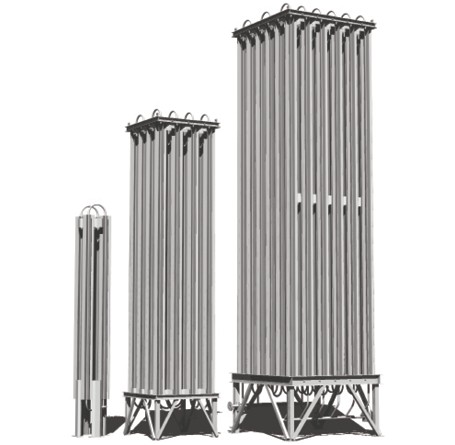
Atmospheric vaporizers are used to convert liquefied gases (such as oxygen, nitrogen, argon, or natural gas) from a liquid state to a gaseous state. This process occurs through heat exchange with the surrounding environment, typically air, without the use of additional energy sources like electricity or fuel.
Main areas of application for atmospheric vaporizers:
- Industry. Supplying gas for production processes, for example, in metallurgy, chemical, or food industries.
- Medicine. Delivering gaseous oxygen to hospitals from cryogenic storage tanks.
- Energy. Utilization in liquefied natural gas (LNG) gasification systems for supplying gas pipelines or power plants.
- Scientific research. Providing gases for laboratory needs.
The operating principle is simple: liquid gas enters the vaporizer, where it is heated by the air temperature, evaporates, and transitions into a gaseous state. This is an economical and environmentally friendly solution since it does not require active energy consumption, but its efficiency depends on climatic conditions— the process may slow down in cold weather.
The performance of an atmospheric vaporizer directly depends on the heat exchanger's surface area, air humidity, and ambient temperature. The highest efficiency in evaporating cryogenic liquid occurs in dry, sunny, windy weather because these conditions minimize frost formation on the vaporizer’s plate surfaces.
To increase the heat exchange area, atmospheric vaporizers are made from longitudinally finned tubes.
When calculating the sufficient working surface of a vaporizer, climatic conditions must be considered—the colder it is, the larger the heat exchange surface needs to be.
| Performance | from 70 to 10,000 Nm³/h |
| Operating pressure range | from 10 to 420 bar |